Scientists Observe Record-Breaking Flare from Distant Supermassive Black Hole
Scientists observed a supermassive black hole 11 billion light-years away emitting a flare with the light of 10 trillion suns, 30 times brighter than any recorded event.



Overview
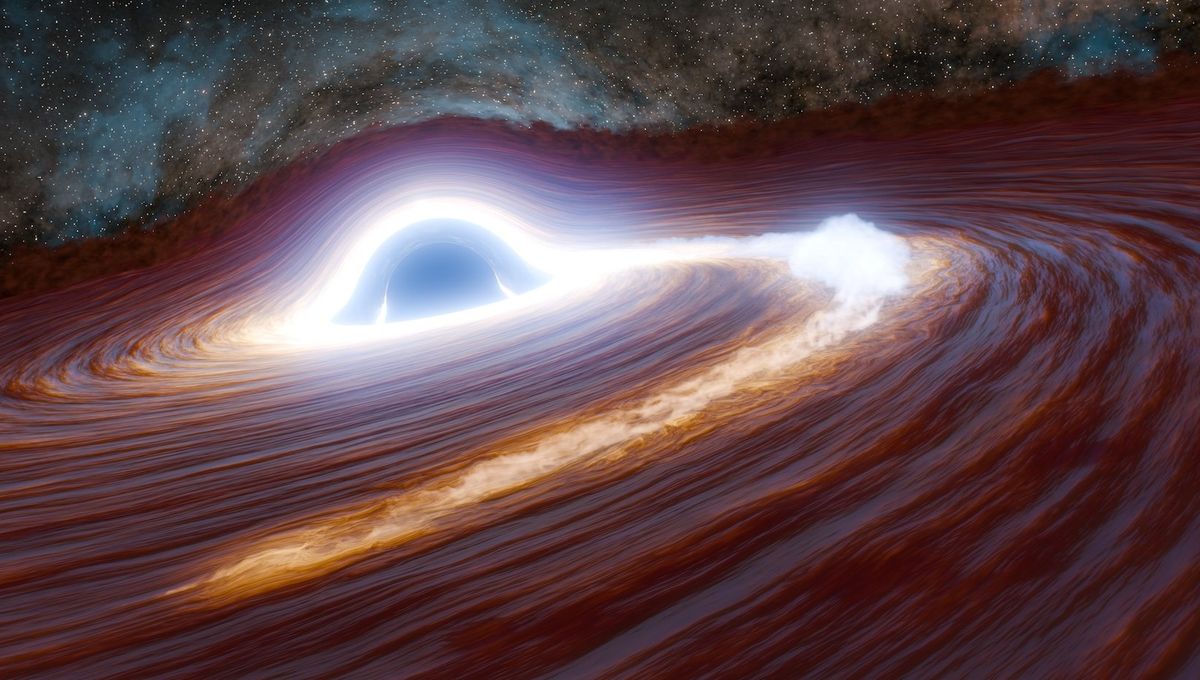
Scientists recently observed a supermassive black hole, 300 million times the sun's mass, emitting an unprecedented flare from a galaxy 11 billion light-years away.
This extraordinary flare reached an intensity equivalent to 10 trillion suns, making it 30 times brighter than any previously recorded black hole event of its kind.
The significant new findings regarding this massive cosmic phenomenon were officially published and detailed in the prestigious journal Nature Astronomy.
Another black hole, J2245+3743, also exhibited a record-breaking bright flare, highlighting the dynamic nature of these colossal celestial objects.
Studying these supermassive black holes helps researchers understand their formation, influence on stellar environments, and the fundamental interactions that shaped the early universe.
Analysis
Center-leaning sources cover this story neutrally, focusing on presenting scientific facts and discoveries without injecting editorial bias. They use objective language to describe the astronomical event, its significance, and related scientific context. The reporting prioritizes clarity and factual accuracy, allowing the scientific information to speak for itself.
FAQ
The flare was likely caused by a large star wandering too close to the supermassive black hole and being shredded to pieces, releasing an enormous burst of light and energy.
The supermassive black hole is approximately 10 to 11 billion light-years away from Earth, meaning we observe the flare as it occurred when the universe was young.
This flare was about 30 times brighter than any previously recorded black hole flare, shining with the light equivalent to 10 trillion suns.
The flare came from an active galactic nucleus (AGN), a type of accreting supermassive black hole estimated to be about 300 to 500 million times the mass of the sun.
Studying these flares helps researchers understand how supermassive black holes form, their influence on their surrounding stellar environments, and the fundamental cosmic processes that shaped the early universe.
